7 Powerful NAP Consistency Tips to Boost Texas Local SEO

If you want stronger NAP consistency and better local search visibility, your business information needs to be accurate wherever customers and search engines can find it. For Texas businesses, that means keeping your business name, address, and phone number consistent across Google Business Profile, directories, social platforms, maps, industry websites, and your own website.
Local citations are not a magic ranking shortcut. However, accurate business information gives search engines more reliable information about your business and location. Google says local results are primarily influenced by relevance, distance, and prominence, and business information can come from the business itself, public websites, third parties, users, and other sources.
For a local business in Houston, Dallas, Austin, Fort Worth, San Antonio, El Paso, or a smaller Texas community, that consistency can make the difference between a clean local presence and a confusing digital footprint.
Quick Answer: What Is NAP Consistency?
NAP consistency means keeping your business name, address, and phone number accurate and consistent across online platforms.
For example:
| Business Information | Correct Version |
|---|---|
| Name | Texas Roofing Experts |
| Address | 123 Main Street, Dallas, TX 75201 |
| Phone | (214) 555-1234 |
The same core information should appear accurately across your Google Business Profile, website, directories, social profiles, maps, and relevant industry listings.
If one directory displays an old phone number, another shows a previous address, and a third uses a different business name, your online business identity becomes less consistent.
Google does not publish a rule saying that every punctuation mark or abbreviation must be identical everywhere. Therefore, the goal should be accurate, recognizable, and consistent business information, not obsessing over insignificant formatting differences.

What Is NAP Consistency?
NAP stands for:
- N — Name
- A—Address
- P — Phone number
These three pieces of information form a basic identity for a local business.
For example, imagine a plumbing company in Plano:
Plano Emergency Plumbing
1450 Legacy Drive, Plano, TX 75024
(972) 555-0182
That information may appear on dozens of websites.
Potential sources include:
- Google Business Profile
- Bing Places
- Apple Maps
- Yelp
- Better Business Bureau
- Chamber of Commerce
- Industry directories
- Local news websites
- Association websites
- Business review websites
- Map services
- The company’s own website
A citation is generally an online mention of a business that includes information such as its name, address, and phone number. Citation management platforms use this information to identify and audit business listings across the web.
Does every citation have to look the same?
Not necessarily.
For example:
123 Main Street
and
123 Main St.
may represent the same address.
The more important objective is to make sure that customers and search engines can confidently understand that these listings refer to the same real business at the same location.
The biggest concern is not harmless formatting variation. It is conflicting information.
For example:
- Old phone number
- Previous business address
- Incorrect ZIP code
- Misspelled business name
- Duplicate listings
- Wrong website
- Permanently closed location still listed as active
These problems deserve attention.
Why Does NAP Consistency Matter for Texas Businesses?
Texas is a particularly interesting market for local SEO because businesses compete across large metropolitan areas and smaller communities.
A business targeting:
- Dallas
- Houston
- Austin
- San Antonio
- Fort Worth
- Arlington
- Plano
- Frisco
- McKinney
- Round Rock
- Waco
- El Paso
may need to establish strong local relevance in a specific geographic market.
Google explains that local rankings primarily depend on relevance, distance, and prominence. Prominence can be influenced by information Google has about a business across the web, including links, articles, directories, and reviews.
That makes accurate business information an important part of building a trustworthy local presence.
1. It Helps Establish a Clear Business Identity
Suppose Google discovers:
ABC Roofing — 214-555-1111
on one website.
Then it discovers:
ABC Roofing LLC — 214-555-2222
on another.
Then it finds:
ABC Roofing — 500 Oak Street
on a third.
Which information should it trust?
A consistent digital footprint gives search engines more supporting evidence about the business.
Google itself states that Business Profile information can be compiled from multiple sources, including public websites, third-party data, user contributions, business owners, and Google’s own interactions with a place or business.
2. It Reduces Customer Confusion
Local SEO is not only about rankings.
Imagine someone searches for an electrician in Houston and finds an old phone number.
They call it.
Nobody answers.
They move on to another company.
You may have lost the customer even if your Google Business Profile is ranking well.
Accurate citations therefore directly improve the user experience.
3. It Supports Local Entity Recognition
Search engines need to understand what a business is, where it operates, and which online references belong to it.
Consistent information across authoritative sources provides additional context.
Think of citations as pieces of evidence that reinforce your business identity.
How Do Local Citations Support Local SEO?
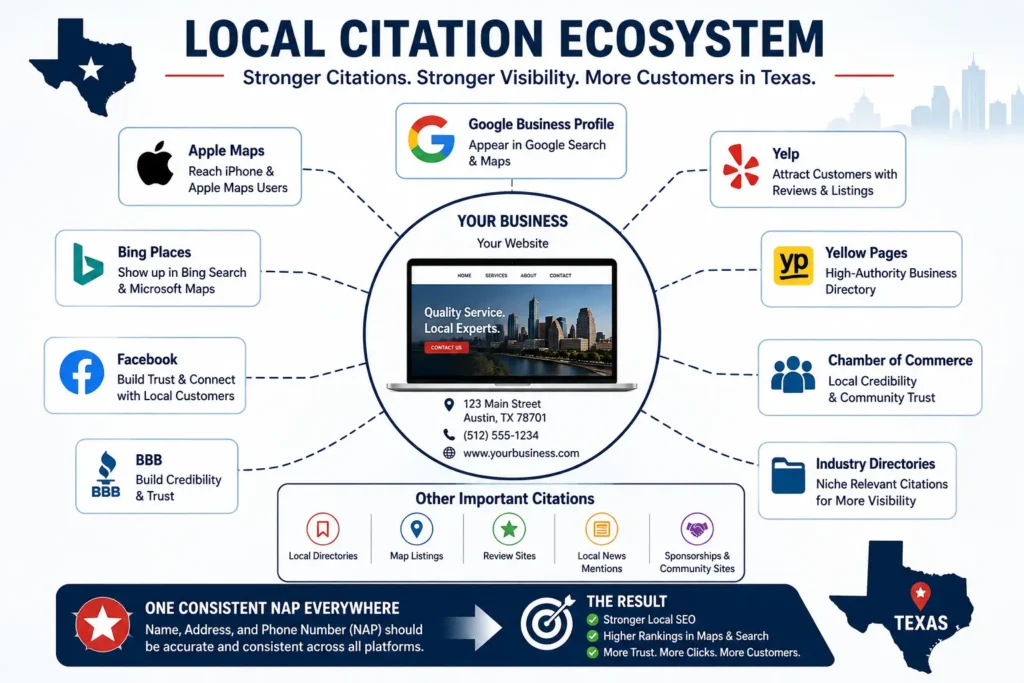
A local citation is an online reference to a business.
Some citations are structured listings.
Others may simply mention the business within an article, association page, local resource page, or other relevant website.
Examples include:
- Directory profiles
- Chamber listings
- Industry association profiles
- Review websites
- Local business directories
- Map listings
- Local news coverage
- Sponsorship pages
Citation signals remain one component of the broader local-search ecosystem.
Whitespark’s 2026 Local Search Ranking Factors study groups citation signals separately from Google Business Profile, review, link, on-page, behavioral, and social signals. The study surveyed 47 local-search experts across 187 factors. Its 2026 analysis also notes that citation influence has declined over time relative to other local signals.
That distinction is important.
Citations matter, but they should not be your entire local SEO strategy.
A strong campaign combines citations with:
- Google Business Profile optimization
- Reviews
- Localized website content
- Relevant backlinks
- Technical SEO
- Local landing pages
- Helpful content
- Strong user experience
- Accurate business information
NAP Consistency vs. Citation Quantity
One of the biggest local SEO misconceptions is:
“The business with the most citations wins.”
It is not that simple.
Consider these two businesses.
| Factor | Business A | Business B |
|---|---|---|
| Citations | 150 | 45 |
| Accurate listings | 70% | 98% |
| Duplicate listings | 18 | 1 |
| Relevant industry listings | Few | Many |
| Google Business Profile | Optimized | Optimized |
| Reviews | 12 | 85 |
| Local links | Weak | Strong |
| Overall strategy | Quantity-focused | Quality-focused |
Business A has more listings.
But Business B may have a much healthier local SEO foundation.
The goal should therefore be:
Accuracy → Relevance → Authority → Coverage
rather than:
More listings → More listings → More listings
BrightLocal’s citation guidance similarly emphasizes accuracy and identifies important citations based on factors including online presence and search engine visibility.
What Are the Top Citation Sources for Texas Businesses?
There is no universal list of directories that every Texas business needs.
The best citation sources depend on the business category, city, service area, and customers.
However, a practical Texas citation strategy can start with major platforms and then move into industry-specific and location-specific sources.
| Citation Type | Examples | Priority |
|---|---|---|
| Google Business Profile | Critical | |
| Maps | Apple Maps, Bing Places | High |
| General directories | Yelp, Yellow Pages | High |
| Social platforms | Facebook, LinkedIn | High |
| Trust/reputation | BBB | High |
| Local organizations | Chamber of Commerce | High |
| Industry directories | Trade-specific directories | High |
| Texas directories | Texas-focused business resources | Medium–High |
| City directories | Local business organizations | Medium–High |
| Niche directories | Profession-specific listings | Medium–High |
| Low-quality directories | Generic mass directories | Low |
1. Google Business Profile
Google Business Profile should normally be the first priority for a local business.
Your profile can appear in Google Search and Google Maps and provides customers with important information such as location, hours, website, phone number, photos, reviews, and services.
Google recommends keeping Business Profile information complete and accurate.
2. Bing Places
Bing’s local business ecosystem can provide another important source of business information.
It is particularly useful for maintaining consistency beyond Google.
3. Apple Maps
Apple Maps is another major map platform.
Businesses should ensure their location, phone number, website, hours, and other important details are accurate.
4. Yelp
Yelp remains an important consumer-facing business directory, particularly for businesses where reviews influence purchase decisions.
However, businesses should not treat Yelp as simply another citation to create and forget.
Keep the profile accurate and monitor customer information.
5. Facebook
A properly completed Facebook business page can reinforce your business identity.
Make sure the:
- Business name
- Phone number
- Website
- Address
- Category
are aligned with your primary business information.
6. Better Business Bureau
BBB can be particularly useful for businesses where trust and reputation are major purchasing factors.
A BBB profile can provide another authoritative business reference while also giving customers additional information about the company.
7. Chamber of Commerce
Texas businesses should investigate relevant:
- City chambers
- County chambers
- Regional chambers
- Industry associations
- Local business organizations
A chamber listing can be more useful than a random directory because it has a clear geographic and organizational connection to the business.
8. Industry-Specific Directories
These can be especially valuable.
For example:
Plumber
- Plumbing associations
- Contractor directories
- Home-service directories
- Local construction organizations
Law Firm
- Bar-related directories
- Legal associations
- Local professional organizations
Dentist
- Dental associations
- Healthcare directories
- Local professional organizations
Electrician
- Electrical associations
- Contractor directories
- Local trade organizations
The closer the directory is to your actual industry, the more meaningful the listing can be.
Which Citation Sources Should a Texas Business Prioritize?
Instead of building 100 random citations, use a tiered strategy.
Tier 1: Core Platforms
Start with:
- Google Business Profile
- Bing Places
- Apple Maps
- Yelp
- Major map and directory platforms
These should contain your fundamental business information.
Tier 2: Trust and Local Authority
Next consider:
- BBB
- Chamber of Commerce
- Local business associations
- Industry associations
- Professional organizations
- Reputable local directories
Tier 3: Industry-Specific Listings
Then build listings relevant to your profession.
A roofing company should not spend its entire citation budget getting listed on generic directories.
Instead, it should look for roofing, construction, contractor, home services, and Texas business resources.
Tier 4: Local Opportunities
Finally, investigate opportunities connected to your actual market.
For example:
- Houston business organizations
- Dallas business associations
- Austin startup communities
- Fort Worth business directories
- San Antonio professional organizations
- Local sponsorship pages
- Community organizations
- Local news websites
Relevance is more valuable than blindly collecting listings.
How to Build Local Citations Correctly
Citation building should be systematic.
Step 1: Create a Master NAP Record
Create one document containing your official business information.
For example:
Business Name: ABC Roofing LLC
Address: 123 Main Street, Dallas, TX 75201
Phone: (214) 555-1234
Website: example.com
Also record:
- Primary category
- Secondary categories
- Business description
- Hours
- Social profiles
- Service areas
This becomes your reference document.
Step 2: Audit Existing Listings
Before creating new listings, search for existing ones.
Search combinations such as:
“Business Name” “Phone Number”
“Business Name” “City”
“Business Name” “Old Address”
“Phone Number” “Business Name”
Citation tools can also identify existing listings, inconsistencies, and competitor citation gaps.
Step 3: Correct Existing Errors
Prioritize:
- Wrong phone numbers
- Wrong addresses
- Incorrect business names
- Duplicate profiles
- Closed locations
- Incorrect websites
Do not immediately create another listing when an existing profile can be corrected.
Step 4: Build High-Value Citations
After cleaning existing information, create missing profiles on relevant platforms.
Step 5: Monitor Changes
Citation management is not a one-time project.
Businesses move.
Phone numbers change.
Websites are redesigned.
Companies rebrand.
Directories update information.
That is why citation monitoring should be part of an ongoing local SEO process.
How Do You Perform a NAP Audit?

A simple NAP audit can be completed in five stages.
Stage 1: Identify Your Canonical Information
Determine the exact business information you want to use as your reference.
Stage 2: Find Existing Mentions
Search Google for:
- Business name
- Phone number
- Address
- Old business name
- Old phone number
- Old address
Stage 3: Record Everything
Create a spreadsheet:
| Website | Name | Address | Phone | Status | Action |
|---|---|---|---|---|---|
| Correct | Correct | Correct | Active | Keep | |
| Yelp | Correct | Correct | Wrong | Active | Update |
| Directory A | Wrong | Correct | Wrong | Active | Update |
| Directory B | Correct | Old | Correct | Active | Update |
| Directory C | Correct | Correct | Correct | Duplicate | Remove/Merge |
Stage 4: Fix the Most Important Listings First
Do not waste hours correcting obscure directories while your Google profile has incorrect information.
Prioritize high-value sources.
Stage 5: Recheck
After making changes, revisit the listings and confirm that the information was actually updated.
7 Powerful NAP Consistency Tips
Tip 1: Choose One Canonical Business Name
Do not constantly change your business name for keywords.
For example:
Correct:
Dallas Family Dental
Potentially problematic:
Best Affordable Dallas Family Dental & Emergency Dentist
Use the real business name according to Google’s Business Profile guidelines and your actual branding.
Tip 2: Keep Your Primary Phone Number Consistent
If your main business phone is
(512) 555-1234
Do not randomly alternate between:
512-555-1234
(512) 555.1234
512.555.1234
Formatting variation is not the same as having a completely different phone number, but consistency makes auditing easier.
More importantly, do not use an old or unrelated number on some listings.
Tip 3: Update Listings When You Move
This is one of the biggest citation problems.
If your Dallas business moves from:
500 Main Street
to:
800 Commerce Street
Update your important listings.
Do not simply create a new profile and abandon the old one.
Tip 4: Watch for Duplicate Listings
Duplicates can create conflicting information.
Search for:
- Duplicate Google profiles
- Duplicate Yelp listings
- Old directory profiles
- Former business names
- Old addresses
Tip 5: Use Relevant Directories
A directory is not valuable just because it exists.
Ask:
Is this website relevant to my business, location, industry, or customers?
If the answer is no, it may not deserve priority.
Tip 6: Keep Your Website Consistent With Your Citations
Your website is one of the most important references for your business information.
Make sure your:
- Header
- Footer
- Contact page
- About page
- Location pages
- Schema markup
contain accurate information.
Google notes that it can use publicly available information from a business’s official website when compiling Business Profile information.
Tip 7: Don’t Stop at Citations
Citations should support a broader local SEO strategy.
Also work on:
- Reviews
- Local content
- Internal linking
- Local backlinks
- Google Business Profile optimization
- Service pages
- Location pages
- Conversion optimization
Common NAP and Citation Mistakes to Avoid
Mistake 1: Building Hundreds of Low-Quality Listings
More is not automatically better.
A smaller collection of accurate, relevant listings can be more useful than hundreds of questionable directories.
Mistake 2: Ignoring Old Addresses
Old addresses can continue appearing online long after a business moves.
Search specifically for your previous address.
Mistake 3: Creating Duplicate Listings
If an existing listing can be corrected, do that instead of creating another profile.
Mistake 4: Using Different Business Names
Do not add keywords to your business name simply because you want to rank for them.
Mistake 5: Ignoring Industry Directories
A local HVAC company may gain more strategic value from reputable HVAC or contractor resources than from dozens of generic directories.
Mistake 6: Treating Citations as a Ranking Guarantee
No legitimate SEO professional should promise:
“Build 100 citations and you’ll reach #1.”
Google’s local ranking system involves multiple factors, including relevance, distance, and prominence.
Practical Texas Example: A Roofing Company in Dallas
Imagine a roofing company called
Dallas Roof Pros
The business operates from Dallas and wants to increase visibility for searches such as:
roofing company Dallas
roof repair near me
Dallas roof replacement
The company discovers the following:
- Google has the correct phone number.
- Yelp has an old phone number.
- Facebook has the correct number.
- A contractor directory has the previous address.
- BBB has the correct address.
- A local chamber listing has the correct information.
- Two generic directories contain duplicate profiles.
The company should not immediately build 50 new citations.
Instead, the priority should be
- Correct the Yelp phone number.
- Update the old address.
- Resolve duplicate listings.
- Verify Google Business Profile information.
- Review website NAP.
- Strengthen relevant industry citations.
- Build local authority through legitimate relationships and links.
- Continue generating genuine customer reviews.
This approach creates a much cleaner local foundation.
How Do Citations Work With Google Business Profiles?
Your Google Business Profile is not isolated from the rest of the web.
Google explains that information in Business Profiles can come from:
- Business owners
- Publicly available websites
- Third-party data
- User contributions
- Other information Google gathers about a local business
Google also says it uses business information to surface relevant local results across Search and Maps.
This is why local SEO should be viewed as an ecosystem rather than a single profile.
Your website says one thing.
Google says another.
Yelp says something else.
Facebook shows an old number.
A local organization shows your previous address.
That creates unnecessary uncertainty.
Instead, your digital footprint should reinforce one clear business identity.
Do Citations Still Matter in 2026?
Yes, but their role has changed.
Citations should no longer be treated as the primary local ranking tactic.
The Whitespark 2026 Local Search Ranking Factors research shows that local SEO involves multiple groups of signals, including Google Business Profile, reviews, links, on-page factors, behavioral signals, citations, personalization, and social signals.
The same research reports that citation influence has continued to decline as a share of local ranking factors, while review and behavioral signals have become increasingly important.
This leads to a practical conclusion:
Citations are foundational, but they are not the whole foundation.
Think of them as part of your business’s digital identity.
Once the identity is accurate, you can focus more aggressively on the signals that help demonstrate relevance, trust, popularity, and customer satisfaction.
What Is More Important: NAP Consistency or Reviews?
Neither should be treated as an either/or choice.
NAP consistency helps establish accurate business information.
Reviews help demonstrate customer experience and reputation.
Google explicitly states that prominence in local search can be influenced by information such as links and reviews and that more reviews and positive ratings can help local ranking.
A mature local SEO strategy therefore combines:
Accurate citations + strong Google Business Profile + genuine reviews + relevant website content + authoritative links.
People Also Ask
H4: What does NAP stand for in local SEO?
NAP stands for Name, Address, and Phone number. NAP consistency means keeping these core business details accurate and consistent across websites, directories, maps, social platforms, industry listings, and your own website.
H4: Does NAP consistency directly improve Google rankings?
NAP consistency should not be viewed as a guaranteed direct ranking boost. Instead, accurate business information helps create a reliable digital footprint. Google uses information from multiple sources when compiling local business information, while local rankings depend on factors including relevance, distance, and prominence.
H4: How many local citations does a business need?
There is no universal number. A better goal is to have accurate listings on important general, local, industry, and map platforms. Quality, accuracy, relevance, and completeness are more useful targets than simply reaching a specific citation count.
H4: Are citations still important for local SEO in 2026?
Yes. However, citations are only one part of local SEO. Current local-search research evaluates citation signals alongside Google Business Profile, reviews, links, on-page, behavioral, and other signals.
H4: What are the most important citation sources?
Start with Google Business Profile and major map and directory platforms. Then add reputable social, trust, chamber, industry, and local sources relevant to your business and market. The right citation sources depend on your industry and location.
H4: What should I do if my business moved to a new address?
Update your Google Business Profile, website, major directories, maps, social profiles, and important industry listings. Search for the old address to find outdated citations and duplicates, then correct or remove them where appropriate.
H4: Can I rank locally without citations?
Yes. Citations are not the only factor determining local visibility. Google states that local results are primarily based on relevance, distance, and prominence. A strong local strategy should therefore include your business profile, website, reviews, links, content, and accurate business information.
The Bottom Line for Texas Businesses
If your Texas business wants better local visibility, start with the basics.
Make sure Google and the rest of the web can clearly answer three questions:
Who are you?
Where are you located?
How can customers contact you?
That is the foundation of NAP consistency.
Then build outward.
Create relevant citations.
Fix outdated listings.
Remove duplicates.
Strengthen your Google Business Profile.
Build genuine reviews.
Publish useful local content.
Earn relevant local links.
Track your visibility.
Most importantly, don’t treat citation building as a numbers game.
A clean, relevant, trustworthy digital footprint is far more useful than a spreadsheet filled with hundreds of low-quality directory links.
For a local business in Texas, the objective isn’t simply to be listed everywhere.
The objective is to be accurately represented everywhere that matters.
Ready to Improve Your Local Search Visibility?

Your business may already have dozens of online listings that you don’t know about.
Some could contain outdated phone numbers, incorrect addresses, duplicate profiles, or inconsistent business names.
A professional local SEO audit can identify these issues and create a prioritized action plan.
Efficiovirtual can help Texas businesses with:
- Local SEO audits
- Google Business Profile optimization
- NAP consistency audits
- Citation cleanup
- Local citation building
- On-page SEO
- Local content strategy
- Website SEO
- Local search optimization
Want to know how consistent your business information is across the web? Start with a citation and local SEO audit.